

I’ve spent a lot of the last couple of months thinking about the year 1966, and what it means for #Nigeria. A symbolic year in a number of ways:
1. The year our first democratic experiment as a nation ended (the First Republic), succeeded immediately by the first of several military regimes.
2. The Nigerian civil war didn’t officially start until 1967, but looking back, 1966 was arguably when the descent began. Had 1966 turned out differently, a Nigeria may have emerged that never saw a civil war.
3. A youth angle: The year that gave us the youngest leaders ever to lead Nigeria. Probably the year in which Nigeria’s modern history was most influenced by young people. We even got a Head of State so young he was unmarried and child-free.
4. The year Dodan Barracks became Nigeria’s seat of power. It would remain so for the next quarter of a century, making it Nigeria’s second-longest-serving presidential residence, after Aso Rock. I have a personal fascination with Dodan Barracks, which has intensified since I saw it up close in January 2023:


6. A year of military decrees, and extensive bans (on political, tribal and cultural organisations), and intense debate about what kind of governance structure the country should adopt—the year of the first Constitutional Conference since Independence. A year of massive changes of political and governmental titles and nomenclature.
7. It was also a year of much high-level bloodshed -- two Heads of State assassinated in the same year, alongside several politicians and military officers. Not like Nigeria had not seen political violence and turmoil—1964 was a pretty turbulent year, marked by electoral violence—but the violence of 1966 was unprecedented. Of course it would then go on to be ecplised by the violence of the following three years. But no one knew this in 1966.
8. Interestingly, on the economic front, as democracy was vanishing, the macro-economy seemed to be picking up. Q1 1966 was an outlier Q1 for external trade since Independence in 1960, delivering a record trade surplus. In fact, the preceding two Q1s, 1965 and 1964, delivered trade deficits.
9. One of the major reasons for this surplus was that Nigeria’s first oil refinery, in Port Harcourt (wholly private at the time, owned and run by a Shell-BP consortium), had opened at the end of 1965, and so Q1 1966 saw a 75% decline in the import of petroleum products.
10. It was also a peak year for Nigerian oil production (soared above 500,000 barrels per day), before the war sent output tumbling. In 1966, the number of companies that had made commercial discoveries of oil in Nigeria jumped from 2 to 7. That’s how big a deal the year was, for oil. You can indeed say 1966 was the year Nigeria’s ‘oil-rich’ status truly began.
Why all the story? I find 1966 fascinating enough to focus on as a history project, as we mark its 60th anniversary this year, 2026. So many threads, so many questions, so many lessons. So much to unpack about a year in which a veil of innocence was lifted, nay, ripped apart.
What should you expect? Stories, dates, interviews, a podcast, videos, essays, in-person events, maybe even a pop-up museum, and a commemorative book. Plenty ideas (because ideas are cheap), let’s see which ones come to fruition.
It will go live here on substack (http://the1966archive.ng will also direct here)
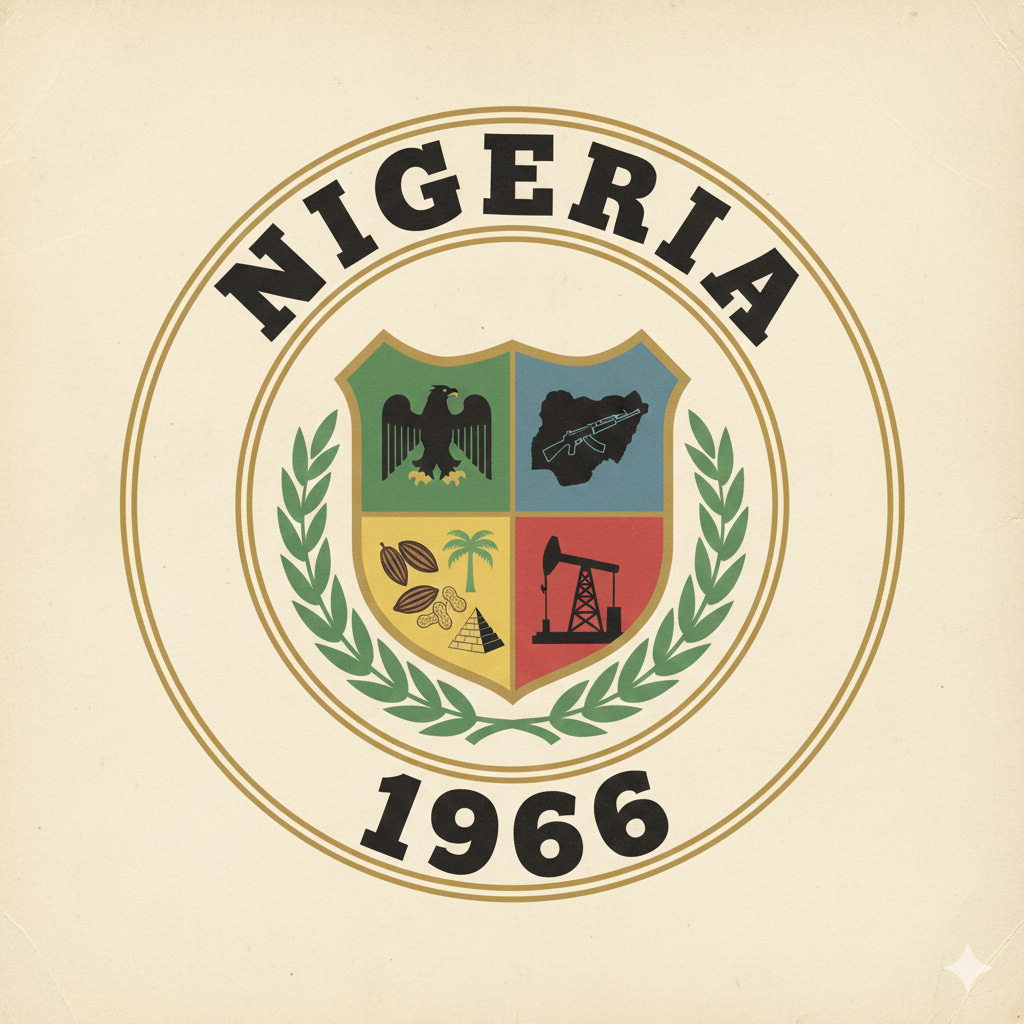
Logo done with the help of Gemini. What does it symbolise for you?